Six months after Pearl Harbor, Japan appeared almost unstoppable. Hong Kong, Malaya, Singapore, and the Dutch East Indies had fallen; the Philippines were being overwhelmed. Yet Pearl Harbor had missed the American aircraft carriers. Admiral Isoroku Yamamoto intended to draw them out and destroy them at Midway. He thought he was preparing an ambush. Admiral Chester W. Nimitz was preparing an ambush for the ambushers.
The war before Midway
Japan’s naval aviation had demonstrated how dangerous the aircraft carrier had become. On 18 April 1942, sixteen American B-25 bombers led by Lieutenant Colonel James Doolittle took off from USS Hornet and struck Japan. The physical damage was small. The shock of an attack on the home islands was not.
Midway, about 1,300 miles northwest of Honolulu, consisted of two small islands inside a coral atoll. Taking it would extend Japan’s perimeter and threaten Hawaii. More immediately, Yamamoto hoped an attack would lure the surviving American carriers into battle. His forces were spread over a vast area; Yamamoto followed aboard Yamato, while Vice Admiral Chuichi Nagumo led the striking force of Akagi, Kaga, Soryu, and Hiryu. The four carriers embarked 248 aircraft. All had participated in the Pearl Harbor attack.
The Americans read enough
American cryptanalysts could not read every Japanese naval message. Fragments of the JN-25 system, traffic analysis, and painstaking reconstruction nevertheless pointed toward an operation against an objective called AF. Commander Joseph Rochefort’s Station HYPO team and Pacific Fleet intelligence officer Edwin Layton concluded that AF meant Midway.
The famous water ruse confirmed an inference already supported by other evidence. Midway sent an uncoded report of a fresh-water shortage; American intelligence subsequently intercepted a Japanese message reporting that AF lacked water. Nimitz learned approximately where and when the Japanese were coming. Japan did not know that he knew.
The people making the decisions
Yamamoto and Nimitz
Yamamoto understood the scale of American industrial power and sought a decisive naval victory before it fully mobilized. But his complicated operation dispersed carriers, invasion forces, battleships, and a simultaneous Aleutian force. Much of Japan’s overall strength could not influence the decisive carrier fight. Nimitz, with fewer ships but better intelligence, placed his available carriers northeast of Midway rather than trying to defend everywhere.
Nagumo, Fletcher, and Spruance
Nagumo faced incomplete reconnaissance, returning aircraft, a combat air patrol to maintain, repeated attacks, and sudden news of American ships. Rear Admiral Frank Jack Fletcher, senior American carrier commander, led Task Force 17 aboard Yorktown. Rear Admiral Raymond A. Spruance commanded Task Force 16, with Enterprise and Hornet, after Admiral William “Bull” Halsey fell ill and recommended him as a replacement.
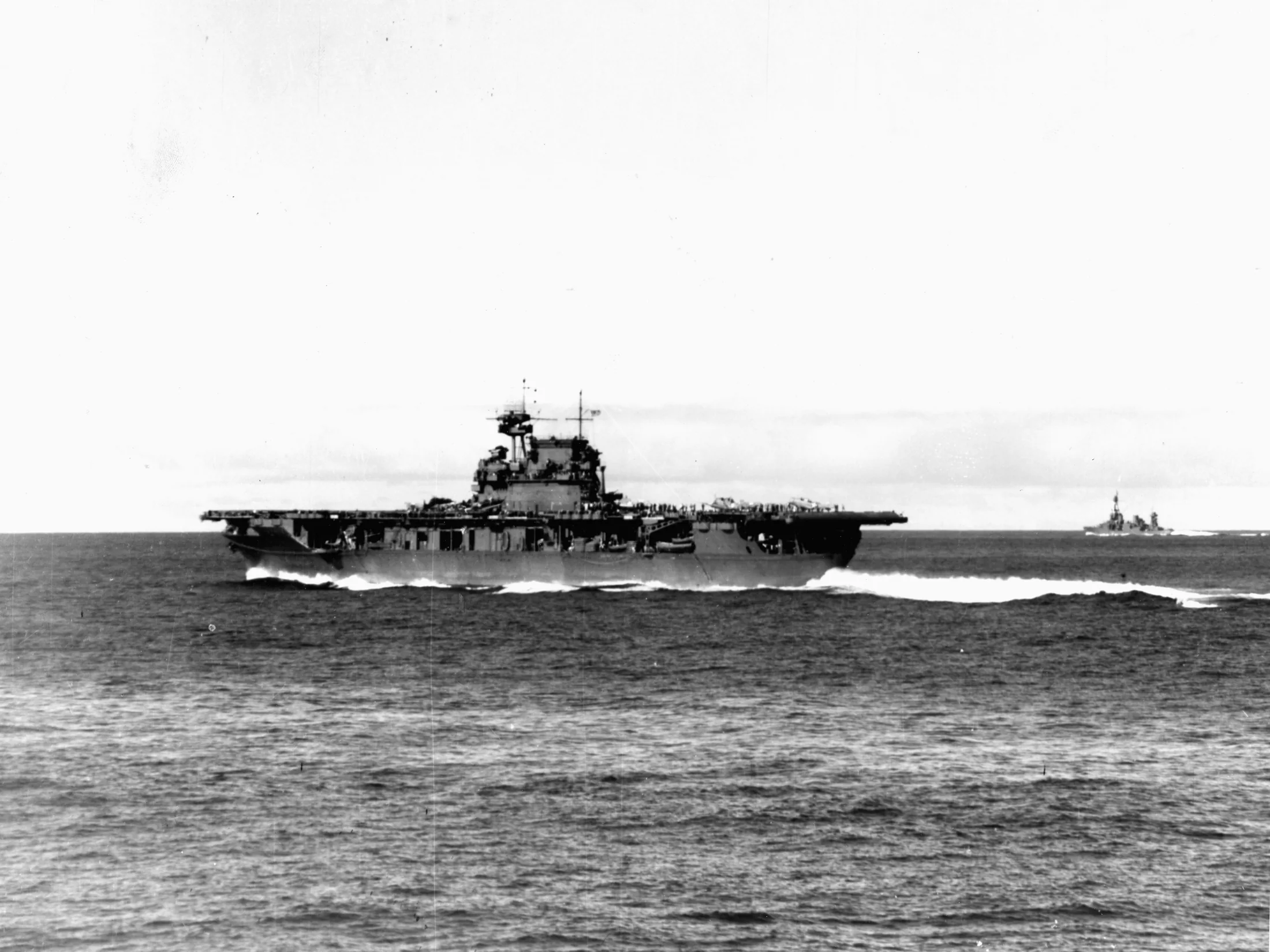
Yorktown had been damaged in the Coral Sea and reached Pearl Harbor on 27 May. Work initially estimated in months was reduced to emergency repairs in roughly three days. She sailed on 30 May. Nimitz thus had three carriers near the rendezvous known as Point Luck.
3–4 June: contact
On 3 June a PBY Catalina from Midway sighted elements of the Japanese invasion force. American bombers attacked without much effect; that night a PBY torpedoed the tanker Akebono Maru. The Japanese were approaching. The decisive fight would come the following day.
Before dawn on 4 June, Nagumo launched 108 aircraft against Midway and sent scouts across the surrounding ocean. The strike damaged the island but did not put it out of action. Its commander, Lieutenant Joichi Tomonaga, reported that another attack was necessary. At about 7:15 a.m. Nagumo ordered his reserve prepared for a second island strike. A scout then reported American ships, and later a carrier. The target had changed while his returning aircraft still needed to land.
The popular image of four Japanese flight decks crammed with fully fueled strike aircraft at the instant the dive bombers arrived is too tidy. Ordnance handling and changing missions created serious problems, but Nagumo’s larger dilemma was operational: recover the Midway strike, defend the fleet, absorb repeated attacks, and assemble an anti-ship strike against carriers he had not expected to find so near.
Spruance launches
Spruance could close the range and reduce his pilots’ fuel risk, or launch early in hopes of catching the Japanese carriers while they recovered the Midway strike. He launched shortly after 7 a.m.; Fletcher’s Yorktown followed later. It was an aggressive decision, and the attacks that followed were anything but orderly. Different formations flew different courses. Some failed to find the enemy at all.
The torpedo squadrons
Lieutenant Commander John C. Waldron led Hornet’s Torpedo Squadron 8 into the Japanese defense without fighter protection. All fifteen TBD Devastators were shot down; Ensign George Gay alone survived. Enterprise’s VT-6 and Yorktown’s VT-3 also took devastating losses. None of the three carrier torpedo squadrons scored a confirmed torpedo hit.
Their attacks formed part of a relentless sequence that gave Nagumo’s force little time to recover. Japanese fighters repeatedly met attackers from different directions and altitudes; the carriers maneuvered defensively while trying to recover and prepare aircraft. The combat air patrol remained dangerous, but it was poorly placed to meet what came next. The familiar claim that the torpedo planes simply pulled every Zero down to sea level and cleared the sky overstates a much messier battle.
The decisive attack
Three carriers in minutes
Lieutenant Commander Wade McClusky’s Enterprise dive bombers were searching for the Japanese fleet as their fuel ran low. He spotted the destroyer Arashi, which had fallen behind after dealing with the American submarine Nautilus, and followed its course back toward the carriers. At nearly the same time, Yorktown’s dive bombers arrived by another route. The convergence was not planned.
At roughly 10:20–10:30 a.m., the Americans struck. Enterprise aircraft hit Kaga repeatedly and Akagi with one decisive direct bomb. Yorktown aircraft hit Soryu. Fires made all three carriers unsalvageable. The surviving records do not support a synchronized, minute-perfect “four minutes,” but the attacks did destroy three operational carriers in an astonishingly short span. That is the truth behind the title.
Hiryu remained. Rear Admiral Tamon Yamaguchi sent dive bombers against Yorktown around noon. Her crew restored enough capability that the later Japanese torpedo strike was reportedly mistaken for an attack on another carrier. It was Yorktown again. Two torpedoes struck; she developed a severe list and was abandoned. The repeated attacks also left the Japanese with an inaccurate picture of how many American carriers remained.
American reconnaissance found Hiryu later that day. Dive bombers hit her around 5 p.m.; she was abandoned and scuttled. With all four striking carriers doomed, Yamamoto abandoned the invasion.
5–7 June: the battle ends
American attacks on the retreating Japanese sank the heavy cruiser Mikuma and badly damaged Mogami. American crews tried to save Yorktown, but submarine I-168 struck her and the destroyer USS Hammann on 6 June. Hammann sank quickly; Yorktown went down on the morning of 7 June.
Japan lost four fleet carriers, Mikuma, hundreds of aircraft, and more than 3,000 personnel. The United States lost Yorktown, Hammann, about 145 aircraft, and 307 people killed. The old assertion that most of Japan’s elite carrier pilots died at Midway is wrong: more than three quarters of its naval aviators survived. Roughly 110 carrier aircrew died, while the loss of the carriers and hundreds of trained aviation technicians and maintainers was catastrophic. Many surviving aircrew would be lost later in the Solomons campaign.
Why Japan lost
There was no single cause. Intelligence let Nimitz position his smaller force; Japanese reconnaissance did not give Nagumo comparable warning. Yamamoto’s dispersed plan left major forces too far away. American commanders launched aggressively, their pilots kept attacking despite terrible losses, and the Japanese carriers had little respite. Damage control and luck mattered too. McClusky saw Arashi. Separate American dive bomber groups arrived together. One hit doomed Akagi. None of this was inevitable.
From here: counterfactual analysis
What if Japan won?
“Japan wins” needs a definition. Trading two Japanese carriers for one or two American carriers is a very different result from destroying Enterprise, Hornet, and Yorktown while keeping several Japanese carriers operational. The following paths explore the latter possibility. They are reasoned alternatives, not events that happened or outcomes we can prove.
1. Japanese scouts find the Americans earlier
An accurate early report could allow Nagumo to give the American carriers priority and attempt a coordinated anti-ship strike before the American dive bombers arrived. American defenses and aircraft would still fight. A simultaneous carrier battle, perhaps costly to both sides, becomes more plausible; victory is not automatic.
2. McClusky misses Arashi
Some American aircraft really did miss the Japanese fleet. If McClusky fails to find the destroyer, his low-fuel dive bombers may have to turn back. Yorktown’s group might still damage one or more carriers, but the near-simultaneous destruction of three becomes much less likely. This small change is one of the most credible routes to a Japanese tactical victory.
3. Akagi survives
Move one decisive bomb a few dozen yards and Akagi may remain operational. Hiryu alone managed two strikes that crippled Yorktown; another surviving carrier might increase the danger to the other American ships considerably. It does not establish that Japan would destroy all three.
Suppose all three American carriers are lost
The immediate effect would be severe. Lexington had been lost in the Coral Sea; three more losses would temporarily shatter American carrier strength in the central Pacific and deepen the shock that began at Pearl Harbor. Japan might retain two, three, or four carriers, depending on the path to victory. From here the branches widen, and confidence declines.
Does Midway fall?
Possibly, but not automatically. The atoll had thousands of defenders, coastal guns, mines, and beach obstacles. Japan assembled several thousand Army and naval landing troops. Without American carrier intervention, Japanese sea and air superiority could isolate and bombard Midway, making its capture plausible. An amphibious assault might still be bloody or fail. Taking the islands would then leave Japan the continuing problem of holding and supplying them.
Would Japan invade Hawaii?
A Midway victory could threaten Hawaii and force a stronger American defense. Conquering and sustaining an occupation of the Hawaiian Islands was a vastly larger amphibious and logistical undertaking. Japan lacked a credible way to turn one carrier victory into soldiers marching through Honolulu.
Guadalcanal and the longer war
The United States historically landed on Guadalcanal in August 1942, before Japan completed its airfield there. With its carriers destroyed, Washington might delay that offensive. Japan could gain time to complete and reinforce the position, making a later Allied campaign harder. Pressure on South Pacific communications and Australia could grow, although an invasion of the Australian continent remained beyond Japan’s practical resources.
American shipyards, aircraft factories, training programs, oil, and population would remain. Essex-class carriers and other new ships were already on the way. A Japanese victory buys time; it does not erase the American ability to replace losses. The war could last months longer, perhaps more, with heavier costs. Specific later battles might shift, but the farther this alternative runs from June 1942, the less confidently anyone can describe its timetable.
Atomic weapons and negotiated peace
The Manhattan Project would continue independently of Midway. If the Pacific advance were substantially behind its historical schedule in 1945, the circumstances of atomic use, invasion planning, and Soviet entry could differ. Naming a particular new target or outcome would be guesswork.
Japan’s strategic hope was to make victory so costly that the United States accepted a settlement, not to conquer America. A crushing Midway victory could strengthen that hope. Pearl Harbor, however, had hardened American resolve, and U.S. production was accelerating. Japan would need a sustained series of victories faster than those losses could be replaced. That becomes increasingly difficult to defend as 1943 approaches.
Conclusion: time and initiative
Midway did not make Japan’s defeat inevitable, and a Japanese victory would not have made America’s defeat inevitable. What the historical battle changed was time, initiative, and strategic freedom. Japan lost four of its best carriers; two months later U.S. Marines landed on Guadalcanal. The transition to Allied offense would be long and bloody, but it had begun.
American intelligence gave Nimitz an extraordinary advantage, yet pilots still had to find and hit the carriers. Many missed. Torpedo squadrons were devastated. McClusky found a destroyer and followed it. A single bomb doomed Akagi. Change a handful of events and June 1942 could end with Japan holding the initiative and America facing a longer, costlier war.
Japan would still face the industrial giant behind the American fleet. Yamamoto sailed toward Midway to finish what Pearl Harbor had begun. Instead, the fleet he expected to ambush was waiting for him, and in a few violent minutes the Pacific War began moving in the opposite direction.
Sources and notes
Where the account comes from
Times in contemporary reports do not always agree to the minute. “Four minutes” is an enduring shorthand for the rapid destruction of three carriers, not an exact stopwatch reading. The alternate outcomes above are labeled as analysis and grow less certain as they move farther from the battle.
- Naval History and Heritage Command — H-006-1 Midway overview ↗
- Naval History and Heritage Command — Battle of Midway, 4–7 June 1942 ↗
- Naval History and Heritage Command — Midway campaign ↗
- Naval History and Heritage Command — USS Yorktown ↗
- Naval History and Heritage Command — Naval cryptanalysis ↗
- U.S. Naval Institute — The Japanese plan to seize Midway ↗
- U.S. Naval Institute — Japan’s plans for Hawaii ↗