Ask an American what Britain was doing in 1812 and you will likely hear about American sailors taken by the Royal Navy, trade strangled at sea, and a young republic defending its independence. Ask a Briton looking toward Europe and you get another picture: Napoleon dominated much of the continent, and Britain was spending ships, money, and men to keep him from dominating the rest. Both pictures are true. Neither is large enough by itself.
Before the wars collided
Britain and France had fought through most of the period since 1793. By 1812, the struggle had become a contest of armies, alliances, credit, shipping, and markets. Britain could not easily defeat Napoleon’s armies on the continent by itself. Its navy could keep open its own connections, attack French commerce, protect an empire, and help pay and equip allies. In Portugal and Spain, British troops fought alongside Portuguese and Spanish forces under Arthur Wellesley, the Earl of Wellington.
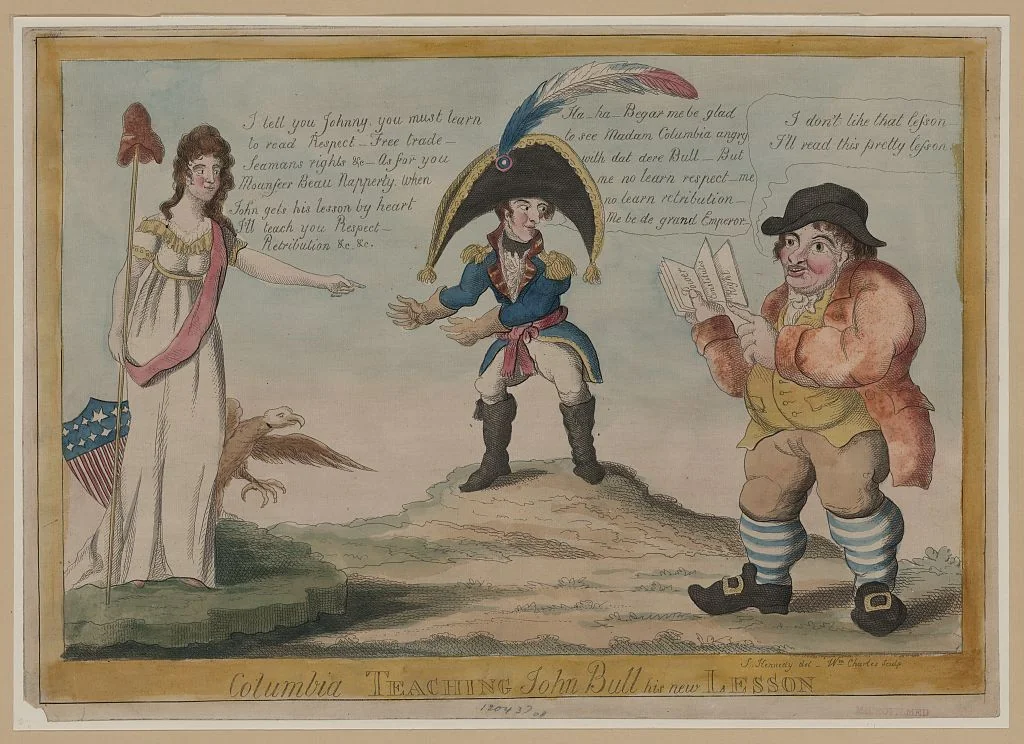
Napoleon tried to shut British goods out of continental Europe. Britain answered with Orders in Council restricting neutral trade with France and French-controlled ports. The United States, a neutral trading nation, stood between the two. Its merchants wanted to trade without either belligerent telling them where they could sail. Each European power insisted its war justified interference with that commerce. The American shipmaster caught between them might have had a simpler description: two great powers treating his neutrality as an inconvenience.
Britain also needed sailors. The Royal Navy stopped vessels and impressed men it regarded as British subjects, including men serving aboard American ships. Americans saw the seizure of sailors under their flag as an attack on national sovereignty. Britain’s view of subjecthood, particularly for people born British, did not vanish because a sailor claimed American citizenship. That legal disagreement had human consequences aboard the ships.
What each side thought it was defending
The American argument
President James Madison’s administration framed the issue as an independent nation’s right to trade and protect its seamen. British maritime restrictions, seizures, and impressment had accumulated over years. Some American leaders also wanted Canada or considered it useful leverage. Those territorial ambitions complicate the claim that the war was solely a defense of sailors’ rights.
The British argument
British ministers saw the war with Napoleon as the central danger. Let neutral carriers trade freely with French-controlled Europe, they argued, and Napoleon could evade economic pressure. But Britain was divided on the policy. Manufacturers and merchants petitioned Parliament, warning that restrictions were damaging British trade and employment too. A Glasgow petition in April 1812 described lost American markets, bankruptcies, and suffering workers. There was no single, contented “British view” of the Orders in Council.
Canada and Indigenous nations
For people in Upper and Lower Canada, the issue was immediate: American armies could cross the border. British regulars, colonial militia, and Indigenous allies defended the colonies. Leaders such as Shawnee chief Tecumseh and Mohawk leader John Norton were political and military actors pursuing their peoples’ own interests, not merely auxiliaries in somebody else’s war. Tecumseh’s alliance with Major General Isaac Brock helped shape the defense of the western frontier. Any account limited to London and Washington misses those stakes entirely.
1812: the decisions meet
May: a crisis in London
Prime Minister Spencer Perceval was assassinated on 11 May. Lord Liverpool succeeded him as Britain faced economic distress, a continuing war with France, and worsening relations with America. In Iberia, Wellington was preparing an offensive. Across the Atlantic, Madison was preparing to ask Congress for war.
June: war and a message too late
Madison asked Congress for a declaration on 1 June. Congress approved it, and he signed it on 18 June. On 23 June Britain moved to suspend the disputed Orders in Council in response to developments concerning France. News could not cross the Atlantic fast enough to prevent the American declaration. This is one of history’s cruel near misses, but it should not be turned into an easy claim that the war would certainly have vanished: impressment, sovereignty, mistrust, and territorial aims remained unresolved.
Summer and autumn: separate maps, one empire
Napoleon invaded Russia in June. Wellington’s British, Portuguese, and Spanish army defeated Marshal Marmont at Salamanca on 22 July, though a failed siege of Burgos later forced a retreat. In North America, British and Indigenous forces captured Detroit in August; Brock died during the defense at Queenston Heights in October. Britain could win in one theater and suffer strain in another. A map of just one war conceals the choices over ships, troops, money, and attention connecting them.
Britain’s strength at sea was immense, but it was not an unlimited pool of ships waiting to be sent to the American coast. Convoys, commerce, blockades, colonial routes, and support for the European war all required vessels and crews. Likewise, American planners could see that Britain’s main military effort lay against Napoleon. They hoped the Canadian colonies might be vulnerable before Britain could concentrate its full strength in North America. Early American invasions showed how difficult that assumption was to turn into victory.
Battleward judgment
The war beneath the war
The disagreement was not simply that one government loved freedom while the other loved power. Britain was defending its position against a dangerous European empire, but its methods harmed neutral nations and its own commercial interests. The United States had a real grievance over sailors and trade, while some of its leaders also saw an opportunity to take territory. Neither side’s stated principles fully explain its choices.
The economics were inseparable from the ideas. A blockade was a weapon against French revenue and supplies. Neutral shipping was American livelihood. Access to American markets mattered to British workers and manufacturers. Canada was a British colony, a home to its inhabitants, and part of an Indigenous struggle over land and political independence. What looked like maritime policy in London could look like unemployment in Glasgow, lost cargo in Boston, or an invading army near Detroit.
1814–1815: the two stories separate again
Napoleon’s first abdication in 1814 released British resources for North America. Britain could apply greater pressure, including operations along the American coast, although more resources did not guarantee a decisive conquest. British troops burned public buildings in Washington that August. British and American negotiators signed the Treaty of Ghent on 24 December 1814; the war ended after ratification in February 1815. News traveled slowly enough that the Battle of New Orleans was fought after the treaty was signed, but before it took effect.
The treaty restored the prewar boundary in broad terms and did not settle impressment in its text. The European circumstances that had made the dispute so combustible were changing as the Napoleonic wars ended. For Americans, the war became another assertion of independence. For Britain, it remained secondary to the struggle with Napoleon. For Indigenous nations, the result was far less reassuring: the hope of a secure political barrier to U.S. expansion had been badly weakened.
Counterfactual analysis
What if the Atlantic quarrel had ended in June?
Suppose Britain had suspended the Orders in Council early enough for the news to reach Washington before the declaration. Opponents of war would have gained a powerful argument. A declaration might have been delayed or defeated. Britain could keep more attention on Napoleon; the United States could avoid an expensive invasion and naval war. That is plausible. It is not certain, because impressment remained a live grievance and some Americans sought territorial gains.
A second path is less peaceful. Suppose Napoleon had defeated Russia decisively and retained his strength in Europe. Britain’s European commitment might have lasted much longer, leaving fewer resources for North America. Yet an American conquest of Canada still would have required effective armies, supply, and political support; British distraction alone would not hand it over.
Finally, imagine Britain and America agreeing on trade while failing to protect Indigenous interests. This is not a small footnote to a happier Anglo-American story. The people of the western borderlands had their own aims, and peace between two Atlantic governments would not by itself settle the conflict over their lands. The strongest counterfactual keeps all the parties on the map.
Conclusion: whose 1812?
From Washington, Britain looked like a former imperial ruler still claiming power over American ships and sailors. From London, America looked like a neutral state pressing its rights while Britain fought Napoleon for survival. From Canada, the invasion was no abstraction. From Indigenous nations allied with Britain, the stakes included territory and the future of political independence.
All of those views belonged to 1812. Britain’s wars were linked by the same fleet, treasury, trade system, and political choices. The conflict with America was smaller than the war with Napoleon in British strategy, but it was not small to the people whose ships were seized, homes invaded, or futures negotiated away. That is why this story deserves more than a battlefield map. It is a study of what happens when a nation’s idea of necessity collides with another nation’s idea of rights—and when both overlook people caught between them.
Sources and notes
Where the account comes from
This article distinguishes documented decisions from the final section’s possible alternatives. British parliamentary petitions show contemporary disagreement about the economic effects of the Orders in Council; they are evidence of the petitioners’ arguments, not a complete statistical measure of national trade. Dates follow the signed U.S. declaration and the British council action, rather than later arrival of news across the Atlantic.
- U.S. State Department — Napoleonic Wars and the United States ↗
- U.S. State Department — War of 1812–1815 ↗
- National Archives — Congress’s first declaration of war ↗
- National Archives — Treaty of Ghent ↗
- National Army Museum — Peninsular War ↗
- National Army Museum — War of 1812 ↗
- National Army Museum — Battle of Salamanca ↗
- UK Parliament — Glasgow petition against the Orders in Council, 24 April 1812 ↗
- UK Parliament — Prince Regent’s declaration on the Orders in Council ↗
- Parks Canada — Fort Malden and the Brock–Tecumseh alliance ↗
- Parks Canada — John Norton and Indigenous participation ↗